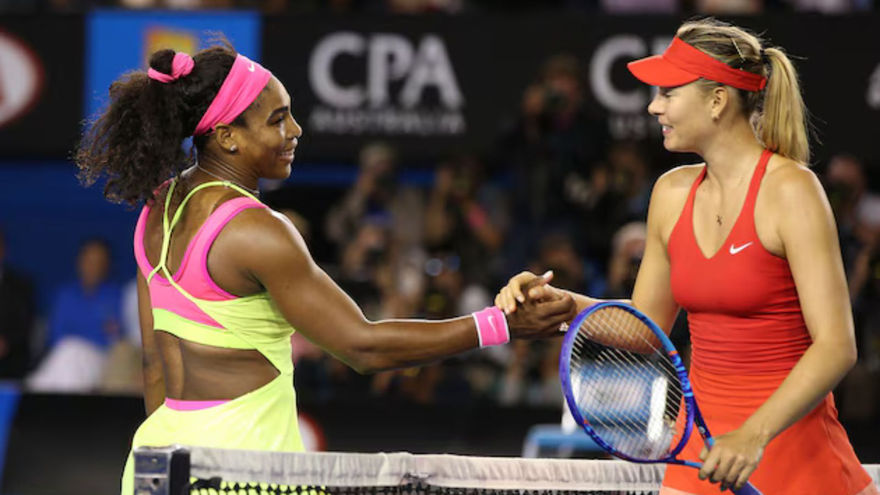

In women’s tennis, few rivalries have burned as fiercely — or lasted as long — as the one between Serena Williams and Maria Sharapova.
It wasn’t just about titles or rankings.
It was about pride, power, and two icons who refused to bow to each other.
Even years after both have left the tour, fans still talk about it — the glares across the net, the icy post-match handshakes, and the words that turned a tennis rivalry into one of the most unforgettable feuds in sports history.
The Spark That Lit the Fire
Their story began in 2004, at Wimbledon — a match that would change everything.
A 17-year-old Sharapova stunned the world by defeating the nearly unbeatable Serena in straight sets to claim her first Grand Slam title.
That victory instantly turned the young Russian into an international superstar — but it also sparked something much deeper between the two champions.
“I think Serena hated me for years,” Sharapova would later write in her memoir Unstoppable.
What followed was not just a rivalry — it was a psychological battle that transcended the court.
The Cold War Years
After that Wimbledon final, Serena struck back — hard.
Over the next 15 years, she would dominate Sharapova, winning 20 consecutive matches against her. Yet every time they faced off, the tension was electric.
There was no small talk, no smiles, no pretense of friendship.
Their matches became more than competition — they were personal showdowns, filled with stares, emotion, and an undercurrent of resentment.
The media played its part too, framing their every interaction as another chapter in tennis’s greatest soap opera. Fans chose sides. Headlines sold millions.
And through it all, both women refused to give an inch.
Beyond the Court — Words That Stung
The feud deepened when Sharapova, in her memoir, claimed that the rivalry had a personal edge — one rooted in envy and personality clashes. She wrote that after her 2004 Wimbledon win, Serena “hated” seeing her celebrated so quickly.
Serena, for her part, rarely addressed the comments publicly — but her game did the talking. Every time they met after that, Serena played with visible determination, often dispatching Sharapova with ruthless precision.
Their dynamic became symbolic of two contrasting forces in tennis:
Sharapova — the cool, marketable superstar;
Serena — the unrelenting powerhouse redefining greatness.
It wasn’t just tennis — it was identity, legacy, and power colliding.
The Respect Beneath the Rivalry
Over time, though, as both careers wound down, a quiet respect began to surface.
When Sharapova announced her retirement in 2020, Serena publicly praised her, calling her “a fierce competitor who always pushed me to be better.”
It was a rare olive branch — one that hinted that, beneath the years of tension, mutual admiration had always existed.
“We both wanted to win, and neither of us wanted to give up anything,” Serena once admitted. “That’s what made it real.”
Their feud may have been toxic at times, but it was also authentic — born out of the raw hunger to be the best.
Legacy of a Rivalry That Shaped an Era
Today, Serena Williams and Maria Sharapova have both stepped away from professional tennis, yet their rivalry remains legendary — not because of how much they disliked each other, but because of how much they pushed each other.
Their story is a reminder that great rivalries are never just about hate — they’re about drive, ambition, and the unrelenting desire to stand alone at the top.
In the end, Serena may have dominated the scoreline, but both women changed the game forever.
Their “war without end” wasn’t really about destruction — it was about destiny.

